Recognize your triggers
Notice the thoughts and physical cues that signal anger is building.

Court-accepted
A weekly group on Zoom, led by a real instructor.
Tuesday, Thursday, Saturday or Sunday classesStart as soon as .
From $36 a class · 4.7 from 904 verified reviews
Accepted nationwide — or your money back.
Education, not therapy or counseling.
$37a class
8 weeks · $295 total
4.7 from 904 verified reviews
Choose your class $360 $295Accepted nationwide — or your money back.
Cancel anytime; future charges stop.
Stop anytime; unused weeks are refunded.
| Length | Pay weekly | Pay once |
|---|---|---|
| 2 weeks · 4 hrs | $90 | $85 save $5 (6%) |
| 4 weeks · 8 hrs | $180 | $159 save $21 (12%) |
| 6 weeks · 12 hrs | $270 | $229 save $41 (15%) |
| 8 weeks · 16 hrs | $360 | $295 save $65 (18%) |
| 10 weeks · 20 hrs | $450 | $359 save $91 (20%) |
| 12 weeks · 24 hrs | $540 | $429 save $111 (21%) |
Choose your weeks, complete a short orientation, and join your first class. Your certificate follows when you finish.
None of these days work?
See the self-paced option
Choose your weeks, complete a short orientation, and join your first class. Your certificate follows when you finish.
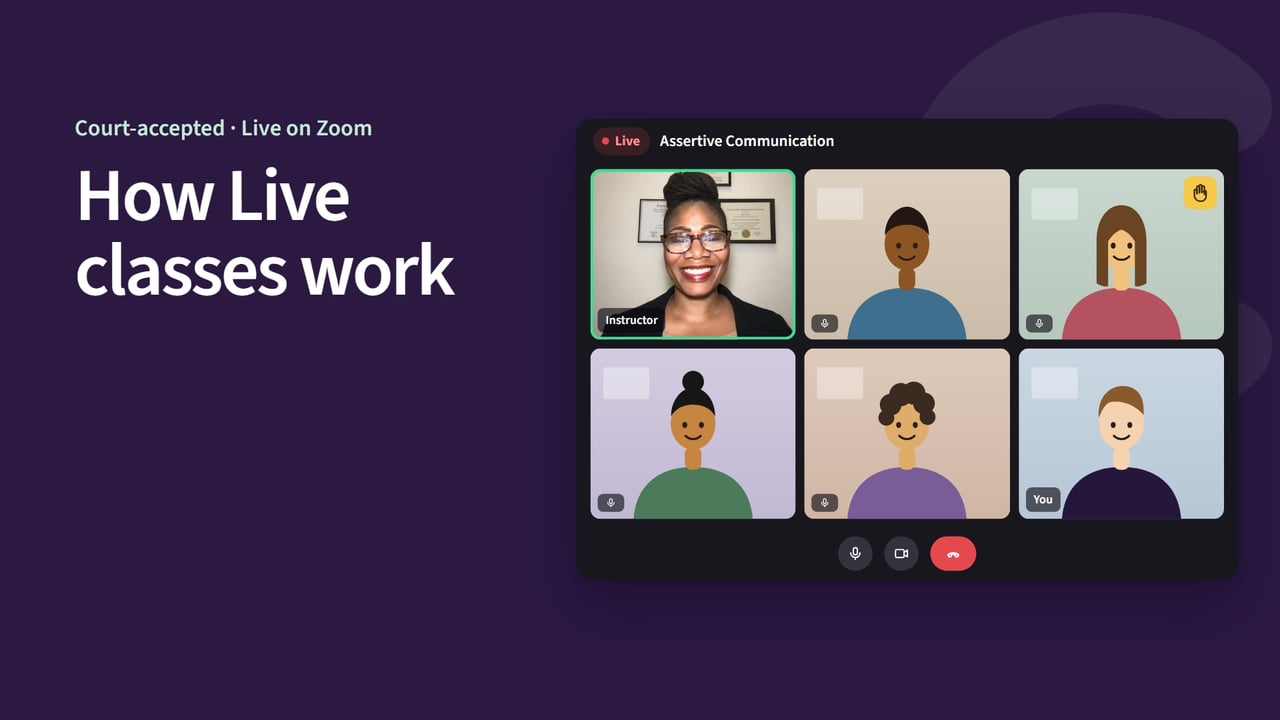
A one-minute walkthrough, narrated, with captions. Select a step to jump to it.
Notice the thoughts and physical cues that signal anger is building.
Practice listening, expressing needs, and setting boundaries.
Find coping strategies to return to in difficult moments.
The curriculum rotates. Each class stands on its own, and you attend the number of weeks you purchase. You don’t need to begin at topic one.
Curriculum by Kendra L. Marien, LICSW, adapted from SAMHSA’s anger-management model.
Each class has its own instructor, who leads it every week: a live lesson, a group conversation, and time to practice a different response.
Open your personal Zoom link on your phone, tablet, or computer. Keep your camera on so your instructor can confirm attendance.
Your instructor teaches one topic and leads discussion and guided exercises, such as recognizing a trigger or expressing a need calmly.
Each two-hour class stands on its own. The following week, you return for another topic and more practice.
Classes are live and aren’t recorded.

Dr. Arlene Archer, PsyD, CAMS-ICertified Anger Management Specialist · Doctorate in Clinical Psychology
Teaches the Tuesday and Thursday classes
Arlene teaches every class live and takes roll call herself. She has taught psychology at the university level and has spent more than two decades leading groups — including many years with people who came through the courts.
Read Arlene’s profile
Dr. Eboni S. Long, PhD, LMFTLicensed Marriage and Family Therapist · PhD in Marriage and Family Therapy
Teaches the Thursday, Saturday and Sunday classes
Eboni teaches the Sunday class live and takes roll call herself. A licensed marriage and family therapist with a PhD in the field, she has spent more than 15 years working with families and adults, including court-referred groups, and today supervises clinicians across a network of substance-use treatment centers.
Read Eboni’s profileYour documents are included, from enrollment through completion, and anyone your court sends can verify the certificate online.
Illustrative document preview. Your details appear on your documents.
Verified endorsements from the people who see the certificates.
“Accepted by every court I’ve submitted certificates to. Courseable is the one I now send my clients to.”

“Meets court-ordered requirements without creating additional burdens.”

“Thorough, easy to access, and court approved.”

“Practical, evidence-based content that’s easy to understand and apply.”
Endorsements refer to Courseable courses generally. Attorney or probation officer? Learn about partnerships.
From the Courseable community
Read our reviews“I took this course for a court requirement, and I went into it with very low expectations. But to my surprise, I found this class to be actually very beneficial as it was packed with really effective strategies. I got my court requirement fulfilled and also improved myself. Thank you!”
Accepted nationwide — or your money back. Full refund if your court doesn't accept it — send us proof within 30 days. The certificate states the weeks you attended, verified by your instructor at roll call, with an online verification code. Read the guarantee.
No. This is a general anger management class — not a certified Batterer Intervention Program (BIP), intimate-partner-violence program, or domestic violence program, which are separate, specialized programs typically run in person over many months. If your court order, probation terms, or a protective order specifically calls for batterer intervention, BIP, or a domestic violence program, this class will not satisfy it. Check your paperwork and confirm with your court before you enroll.
Choose your class when you enroll — classes meet every Tuesday, Thursday, Saturday and Sunday, you attend the same class each week, and new students join at any class. Enrollment in a class closes 1 hour before it starts; your first class is the next one after that. Each weekly class is two hours, so eight weeks means eight attended classes. Every topic stands on its own. Next classes: Tue, Oct 27 · 6:00 PM CT, Thu, Oct 22 · 6:00 AM CT, Thu, Oct 22 · 7:00 PM CT, Sat, Oct 24 · 8:00 AM CT and Sun, Oct 25 · 6:00 PM CT.
No Zoom account — you get a personal join link for each class, and you can join from a phone, tablet, or computer with a working camera. Keep your camera on, with your face visible, for the whole class. That's how your instructor confirms you attended. Classes aren't recorded, and you may not record, screenshot or share them.
Your enrollment includes one excused absence. Each further missed week uses one of your purchased weeks; to keep attending you buy a make-up week from your class page. A class Courseable cancels never counts against you.
Pay $45 a week and cancel anytime, or pay upfront and save:
2 weeks (4 hours): $85 upfront or $90 paid weekly
4 weeks (8 hours): $159 upfront or $180 paid weekly
6 weeks (12 hours): $229 upfront or $270 paid weekly
8 weeks (16 hours): $295 upfront or $360 paid weekly
10 weeks (20 hours): $359 upfront or $450 paid weekly
12 weeks (24 hours): $429 upfront or $540 paid weekly
The weekly plan is $45 a week. Week 1 is charged when you enroll. Each following week is charged automatically 24 hours before its class, until your weeks are paid. Cancel anytime from your class page and future charges stop. Weeks already charged aren't refunded, except week 1 if you cancel more than 24 hours before your first class. The total shown assumes you complete all your selected weeks. Prefer one payment? Choose Pay once instead. Stop anytime: email us and the weeks you haven't used are refunded, pro-rated. See the refund policy.
Your instructor takes roll call at every class and marks you Present, Partial or Absent. Only weeks your instructor marks Present count toward your certificate. Joining more than 10 minutes after class starts, or leaving more than 10 minutes before its scheduled end, is marked Partial, which counts as a missed week. Keep your camera on, with your face visible, for the whole class. That's how your instructor confirms you attended. If your instructor can't see you and you don't turn your camera on when asked, you're marked Partial. If they never see you on camera, you're marked Absent. Zoom join and leave times are recorded as supporting evidence. That instructor-verified record is what backs your certificate.
Proof of enrollment as soon as you enroll, a week-by-week attendance record you can download mid-course, and a completion certificate the day you attend your required weeks. The certificate states the weeks your instructor confirmed — for example Anger Management Course (Live) (8 Weeks Attended) — and includes an online verification code.
Match it to your court order. Ordered a number of hours? Each week is 2 hours: 8 hours = 4 weeks. If you're not sure, send us the paperwork and we'll help.
Yes. Tuesday classes meet at 6:00–8:00 PM, Thursday classes meet at 6:00–8:00 AM or 7:00–9:00 PM, Saturday classes meet at 8:00–10:00 AM and Sunday classes meet at 6:00–8:00 PM Central; your dashboard and class reminders show every class in your own time zone, and the “Next class” line on this page does too when your zone differs. Anyone in the US can attend — the live class is not limited by state.
Our self-paced course lets you study independently at any time. Its certificate states hours completed; this live class states weeks attended. If your order requires live attendance, confirm the format with your court before choosing self-paced.
No. Completion is based on attendance confirmed by your instructor at roll call, not on a test.
Join any week, as soon as .
Have a question? Let’s talk.